
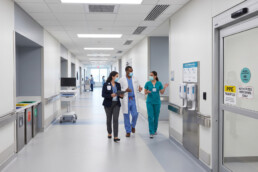
Infrastructure Design and Infection Control
The Building Is the First Infection Control Protocol
Every infection control protocol in a hospital operates inside a physical environment that either amplifies or limits its effectiveness.
HAI rates in Indian ICUs hit 17.7% — highest globally.
Most hospitals treat it as a protocol problem. The evidence says it's a design problem.
Layout determines if hand hygiene compliance is physically possible. HVAC pressure zoning either contains transmission or enables it. Surface materials either harbour pathogens or resist them. Isolation infrastructure either exists at design stage or cannot be retrofitted.
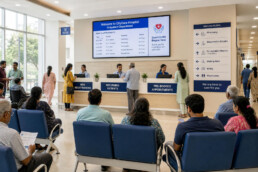
What an Efficient OPD Actually Looks Like
Patients spend 85% of their OPD visit waiting, not in consultation. That's not a staffing problem. It's a design problem.
Most OPD layouts default — single registration counter, distant diagnostics, waiting zones with no visibility to queue status. Every design decision deferred becomes a bottleneck built in.
An efficient OPD design is a specific spatial outcome. The article walks through registration configuration, consultation room sizing, diagnostic adjacency, waiting zone design, and staff circulation — the five design decisions that determine whether an OPD flows or stalls.

How Infrastructure Design Impacts Clinical Outcomes
Hospital design is a clinical decision.
From department layout and daylight to acoustics, HVAC zoning, and material selection — every design choice affects how patients recover and how safely care is delivered.
Our latest article explores how healthcare infrastructure can support better clinical outcomes.

Common Site-Level Mistakes in Healthcare Construction
In healthcare construction, site decisions become clinical decisions. Orientation, drainage, vehicular movement, geotechnical planning, and utility placement can directly affect infection control, emergency access, maintenance, and long-term hospital performance.
This article highlights the most common site-level mistakes in healthcare construction — and how to prevent them early.

Negative Pressure Rooms in Hospitals
Negative pressure rooms (NPRs) may occupy a small footprint in a hospital, but their performance has a disproportionate impact on infection control, workforce safety, and regulatory compliance.
When designed and commissioned well, NPRs contain airborne pathogens, reduce cross-transmission, and keep critical spaces operational. When they fail, the failure is usually quiet - through leakage, mis-zoning, or untested systems.
In this article, we break down how negative pressure rooms work, why zoning and sealing matter as much as HVAC, and why commissioning and facility operations determine long-term reliability.

Designing for Night-Shift Healthcare Workers
Hospitals run 24/7, but most design decisions are made with daytime workflows in mind.
We’ve been studying how night-shift teams function — their physiological dips, the silence that amplifies stress, the reduced staffing, the heightened safety needs — and how thoughtful design can directly support alertness, wellbeing, and clinical safety during those hours.
This article explores how lighting, circulation planning, material selection, acoustics, and restorative staff zones can make night shifts significantly safer and more supportive.

The Science of Hospital Windows
Windows in hospitals do far more than bring in light; they influence recovery rates, infection control, and even staff productivity.
In this article, we unpack the science behind hospital windows - how light, air, and design come together to create safer, healthier healing spaces.

How Design Impacts Patient Care
Ever wondered what goes into designing a hospital or clinic that truly works - for doctors, staff, and patients?
At Shree Designs, we ensure every space is functional, compliant, and designed for healing. From optimized layouts to smooth execution, our process supports better care and practice.
Take a look at how we design and build healthcare spaces that truly heal.

Textures in Healthcare Spaces
When designing hospitals or clinics, texture is often seen as a “finishing touch.” At Shree Designs, we use texture as a strategic design tool - not only for its decorative aspect. Low-sheen surfaces in waiting areas to micro-textured finishes in ICUs, every choice is calibrated for performance and comfort. The right textures can help reduce patient anxiety, improve wayfinding without extra signage, and support staff wellbeing.
Explore how we design with texture, intention, and compliance in this article.

The Lifecycle of a Healthcare Facility Design
Ever wondered what goes into designing a hospital or clinic that actually works - clinically, functionally, and visually? At Shree Designs, we follow a 6-stage process that starts with your clinical vision and ends with real-world feedback after handover.
From zoning to NABH, from site flow to materials - see how it all comes together in this infographic that details the lifecycle of a Healthcare Facility Design